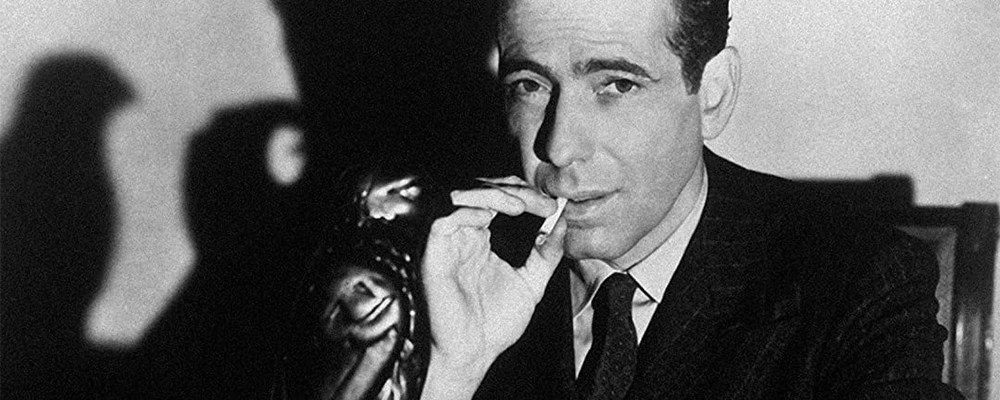
Film Noir evokes rain drenched streets, femme fatales with a gun in their purse, and most of all, the cynical, perversely honourable men who populate these black and white films. George Raft, handsome, sexy and just this side of civilised leaning against a lamppost in 1930s Shanghai; Humphrey Bogart cradling the Maltese Falcon in his hands as he walks away from greed and corruption; Dick Powell playing all the angles but doing the right thing anyway are unforgettable anti-heroes. Critic Marc Norman dismisses the Film Noirs as a false flash of creativity where crime is disguised as something else. Luc Sante, in O.K. You Mugs thinks that “two hours in the dark can be nothing less than a life or a lesson or a trip”. The Film Noirs are more than a life, a lesson, a trip; they are a love affair.
Film Noir existed for only a brief period time, from the end of World War II until 1958 when Orson Welles made Touch of Evil, widely acknowledged as the last of the true Noirs. The pervasive mood of these films was pessimistic, alienated, riven with guilt, paranoia and desperation. The Noirs encapsulated the darkness of post-war Europe, the shadowy beginnings of the Cold War and the spreading tentacles of organised crime as it moved from running bootleg whiskey to running governments. Life in the Noirs is built on quicksand; a stroll down the wrong street, as in the Woman in the Window or Scarlett Street, leads to blackmail, murder; a visit to a client, in Double Indemnity, almost sends the hero to the gas chamber; a drink with a girl in a bar ends in bloodshed in The Big Clock. Innocence is no guarantee of safety in the Noirs. Richard Conte is framed for murder by a corrupt lawyer in Cry of the City; Joan Crawford almost goes to jail for a murder her daughter committed in Mildred Pierce; in Beyond a Reasonable Doubt a journalist is trapped in an elaborate scheme and convicted of murdering a woman. These films revolve around two themes that are deeply rooted in the Noirs. When the main character in The Dark Corner says “I am backed up in a corner and I don’t know who is hitting me”, he perfectly captures the senseless randomness at the heart of the Noirs. The Noirs look up at life from the position of criminals, losers, the unwanted and the unlucky. Life is a roulette wheel and nothing can stop a losing streak. Despite most of the Noirs ending with some sort of restitution of order, the stories imply that in the world evil wins, good is not rewarded and people may be innocent of committing a crime but they are not innocent of evil thoughts. They are not innocent of an innate weakness that leads them, however unconsciously, into a confrontation with the darkness at the centre of the human soul.
The Roots of Noir
The roots of the noir style can be traced back to three sources. The first is the literary side. Film Noir drew its source material from the hard-boiled crime fiction of Raymond Chandler, Dashiell Hammett, James M. Cain, and Cornell Woolrich, all published in the pulp magazines of the 1920s and 1930s. Critics were not impressed with the edgy, cynical sagas put out by Chandler and his like. One dismissed them as the ‘poets of tabloid murder’. The heroes of these stories was detached, emotionally self-contained but with a working moral compass. The hero could use violence to contain violence, twist the law to uphold the truth, resort to devious means to get the job done but he was never for sale. He had a fundamental integrity that set him apart from ordinary men and forced him to set things right, regardless of the personal cost. The work of these writers were among the first of the Noirs, beginning with Hammett’s Maltese Falcon (1941), Woolrich’s Phantom Lady (1944), Chandler’s Murder My Sweet (1944) and the Big Sleep (1946) and Cain’s Double Indemnity (1944) and The Postman Always Rings Twice (1946). The noir writers were heavily influenced by Ernst Hemingway’s sparse, macho style of writing with its terse language, sparse descriptions and tightly coiled characterisations. Film critics dismissed these as crime stories with no redeeming value.
The second influence gave the Noirs their distinctive visual style. The cinematic style of the noirs can be traced to German Expression of the 1910s and 1920s, with its focus on uncovering hidden truths. Films like The Cabinet of Dr Kalagari (1919), Nosferatu (1922), Metropolis (1926) and M (1931) were all dependent on evoking mood and tension to express the inner paranoia and moral breakdown of the characters. They were filmed in controlled settings; often claustrophobic studios with little space or light. Camera angles were distorted to heighten the tension. Chiaroscuro lighting distorted the scenes even further. These elements slipped over into film noir although they were muted for American audiences. In moments of tension, the Noirs crawl with shadows; Dana Andrews running through the streets in Where the Sidewalk Ends, Humphrey Bogart sitting alone in his office in The Maltese Falcon trying to figure out who gunned down his partner. The Noirs were usually set in urban locations, neon lights flash on and off to signal moral dilemmas or to demarcate the line between high society corruption with its soft silken whispers and expensive whiskeys and the seamy, seedy world of the streets where nobody has the time or energy to hide it. They are too busy trying to make a living in a world without choices. In Crime Wave (1954), Gene Nelson plays ex-con Lacey who has spent the last two years trying to make a clean life with a good woman. Three former prisoners show up with a plan for a heist and force Lacey to get involved. It all goes wrong when one of them is killed and Lacey is framed for his murder. The film is replete with darkened alleys and moody lighting as Lacey fights to prove his innocence. In Murder My Sweet (1944), the murderous woman at the centre of the story switches on a lamp on to signal to her accomplice that the target is lined up ready to kill.
Finally, while it is natural that the evocative moods and dangerous ambience of German Expression should seep into the Noirs, the move was helped by the fact that many of the Noir directors were Europeans who had fled both fascism and communism. Fritz Lang, Otto Preminger, Richard Siodmark, and Billy Wilder had all worked in Germany or France or Austria before arriving in Hollywood. They shared a cynical view of a world where humans were merely chess pieces being moved back and forth over corrupt, seamy boards. Lang and Siodmark excelled in presenting obsessive, tormented characters whose inner turmoil is counter balanced by glacial detachment and surgically precise camera angles. Siodmark is noted for highly compressed situations; his characters are boxed into corners or trapped inside some kind of maze. Wilder drenched his films in social commentary, tackling alcoholism, infidelity and domestic violence while Preminger concentrated on social intersections, placing down beat cops inside high society dens as in Laura (1944). Noir attracted directors whose work was methodical and controlled rather than spontaneous or improvisational. The Noir directors want to tell the stories of lives unravelling but they do it with icy detachment; they are not interested in evoking sympathy or offering comfort. There are no tears, no mawkish sentimentality in Film Noir.
The Noir directors work with three types of characters – the truth seeker, the femme fatale and the hunted. In Siodmark’s The Killers, the main character, Swede passively submits to his own death by two hired executioners. Swede, a former boxer with ties to organised crime and the victim of a double cross by the woman he loved, simply hides out in rural America until his past catches up with him. The Noirs revolved around two stories, albeit with multiple twists and angles. These are the haunted past that will resurface in the present and the fatalistic future nightmare that will unfold from present actions. Noir characters are rarely without troubled pasts, and almost inevitably they will make a decision, out of greed, weakness or unchecked emotion that will lead to disaster. Mildred Pierce may not have killed her last husband but she is capable of it. Swede sold out to the racketeers long before his girlfriend set him up and walked off with the money. Barbara Stanwyck, in Double Indemnity, kills as easily as she seduces and both are in pursuit of the insurance money that she needs to walk away from small town life.
The Time of the Noirs
Film Noir was always the underdog of cinema dismissed as unworthy, shabby and down at heel by contemporary critics and film-makers. Its heyday was a brief period almost seventy years ago. The Noirs were films painted in a million shades of grey. There is nothing like them now. The writers and directors and actors who made them have long vanished from the world, but their legacy lives on doing “that thing that can’t be done, though the movies come the closest. It’s to stop time, hold the best of it in your hand”.
The Noirs are a compass rediscovered, a map unfolding, a heart still beating against all the odds. The Noirs are Ida Lupino, dripping diamonds and glamour, negotiating business deals with gang bosses over a martini. The Noirs are Ann Southern or Mari Windsor, bad girls with bruised hearts and a penchant for the wrong man…brave little chippies who will gamble all the diamond bracelets and mafia wise guys in the world for just one more chance at happiness. Lipstick and high heels and smart-mouth sarcasm are the armour of women who have had to claw their way through life. The Noirs are James Cagney, brutal gang leader in Public Enemy, going to the electric chair crying like a girl so that the young boys who want to emulate him will be so repulsed by his cowardice they will turn away from a life of crime before it is too late.
One of the most authentic moments in Film Noir occurs part way through Casablanca. Victor Laszlo and Rick Blaine, rivals for the same woman, meet in a darkened bar, One is an idealist leader, the head of the anti-Nazi resistance in Europe, the other a cynical bar-owner hiding from a broken heart and broken dreams. Laszlo tries to convince Rick to sell him Letters of Transit that will allow him to escape from German authorities. Laszlo reminds Rick of his past, running weapons into the Ethiopian resistance, fighting fascism in Spain. Laszlo, survivor of a concentration camp and wise in matters of the heart, reminds Rick that “if we stopped breathing, we would die. If we stopped fighting our enemies, the world would die.” Blaine tells him the world would be better off out its misery. Laszlo is having none of it. He knows a hero when he sees one, even if that hero has forgotten what it means to believe in something. Laszlo refuses to let him fall away. Rick does not disappoint him or himself. Director Michael Curtiz drenches the final scene of the film at the airport in the moody greys and rainy concrete that is so iconic to Film Noir. Rick does what has to be done, although the personal cost is high. Laszlo has expected no less of him and says as much when he says “welcome back to the fight. This time I know our side will win.”
In the world of film noir, real men have tenderness, honour and intelligence. They use their courage and perceptions to uncover truth and to protect women and the dignity of old men. They stare life straight in the face, not flinching from what they find. They navigate corrupt worlds with only their independence of spirit and their inability to sell out as beacons in the night. In real life, such men are as rare as endangered wolves, if they even exist at all. Chandler wrote of characters that “lived in a world gone wrong, a world where the streets were dark with something more than night.” In the Noirs, “down these mean streets a man must go who is not himself mean, who is neither tarnished nor afraid”. In The Maltese Falcon, Detective Sam Spade rescues the falcon from greedy hands and corrupt transactions. He replies with the most perfect description in, and of Film Noir…” It’s the stuff that dreams are made of”.
 hollow places