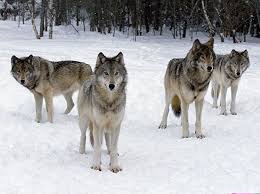
Wolves are one of the last great free spirits left in a world hurtling towards standardisation, uniformity and mediocrity. Wolves represent the poet voice, still moved by moonlight and northern winds, still searching for wild, untamed places, still drawn by unexplored, free spaces. They are the guardians of the wild, in ways humans are only just beginning to understand.
Wolf numbers are diminishing rapidly, often hunted to extinction or confined to ever shrinking spaces. There are less than 200,000 wolves left in the wild. Most people see wolves as predators, invaders who must be hunted down so as to preserve farming stock or local wildlife. Wolves certainly suffer from a bad reputation, often portrayed in film and literature as embodiments of dark forces, or harbingers of doom and catastrophe. The myths of the alpha male and the lone wolf as dangerous assassins persist to this day.
Scientists identify 40 sub-species of wolves and there are two main species, the grey wolf and the red wolf. Wolves are scattered across the world, often evolving the dominant colourings of their native habitats. Arctic wolves have the pure white colouring of snow and moonlight, Ethiopian and Egyptian wolves are dark red and speckled with sand coloured fur. Eurasian Grey Wolves roam widely, their fur the soft colours of smoke and pale shadows. Wolves mate for life, often producing many litters of baby wolves in a lifetime. Contrary to popular belief, wolves often live peacefully together in packs. Wolf society has complex rules of hierarchy and behaviour, with dominant males ruling the pack and determining the direction the wolf pack travels. Wolves are aggressive when hunting but rarely turn the aggression onto other pack members. The snarling aggressive behaviour observed between wolves has long been interpreted as fighting but is, in fact, a form of bluff and play that establishes dominance and social behavioural norms within the pack. The pack forms closes bonds under the rule of the dominant male, whose position emerges because of his role and his qualities. Studies since the 1970s that portray the alpha male as a violent ruler, born from blood-letting, are outdated and had usually only observed wolves in captivity. In the wild, wolf packs are based on family lineage, with male wolves leaving the pack to form their own pack when they mate and have cubs. Aggression between wolves can increase in the winter months, when young wolves are searching for mates.
Wolves travel long distances, often in line formation. In such formation, the older and weaker wolves head the line, followed by five or six strong healthy males, then the rest of the pack consisting of juvenile wolves and females. At the tail end of the pack are more strong wolves and bringing up the rear is the dominant or alpha wolf, whose positioning allows him to observe both his pack and the surrounding environment. The older wolves at the front set the pace and rhythm of the pack, and are at the front so that they will not be cut off and lost. Young males are expected to protect the females and cubs and vulnerable pack members, which is the reason they are scattered throughout the pack when it travels.
Wolves hunting display a sophisticated form of pack intelligence. The whole pack hunts, with individual members taking on different roles. Wolves will track their prey for days, assessing, observing and using forms of distraction and randomness to separate a target elk or deer from the rest of the herd. Strong young males conduct the actual hunt, with younger cubs observing and learning from the sidelines. Older, wiser wolves or dominant males determine the target and can call off a hunt if the circumstances are hazardous. Wolves are mainly hunters and are not equipped with sharp claws or teeth to make quick kills and so must surround and exhaust their prey. During a hunt, wolves communicate through subtle changes in body language and expression, often running silently alongside a herd for long periods of time and forming seemingly random patterns of movement that confuse and worry the target herd. Often wolves will bite the nose or face of a prey animal. This is actually a defensive mechanism as a kick or attack by a larger animal with strong hooves can kill or maim a wolf.
When not hunting, wolves add vocalisations and howling to their communications, often varying the pitch and timbre of the sounds in random ways. This is designed to confuse outside observers as to the size and number of the pack. Wolves spray their territory with urine and faeces which lets other wolves know the land is ‘owned’ by a specific pack and should be avoided. Wolves spend a lot of time playing, especially with young cubs, and this forms an important part of the child rearing process. Baby wolves learn to fight and bond through these forms of play.
Poet Joseph Bruchac writes that when the wolf leaves the earth “climbing higher and higher, each place he stepped, the sky filled with stars”. In places where the wolf has been reintroduced and allowed to live peacefully, damaged ecosystems begin to heal. Yellowstone Park is the best documented case of the cascading impact of the wolves returning. The ancient balance between the wolves and the land is reasserting itself as prey numbers and behaviours change-grazing elk have been forced to change their patterns of continual grazing by the rivers, allowing the rivers to once again become safe havens for native birds, fish, beaver and vegetation. This stabilises the habitat and manages erosion, and so the rivers have changed their patterns of flowing since the wolves returned. In parts of north America, sacred to the Anishinaabeg First Nations peoples, their fight to keep the wolves listed as an endangered species and protected from hunters has allowed wolf numbers to increase on the reservations. The number of ecologically fragile, culturally sacred places still left on the earth is diminishing rapidly and the plight of the wolves is a marker of the disintegration.
In Chernobyl, still unfit for human habitation decades after a devastating nuclear meltdown, the wolf population has increased. In Chernobyl, still unfit for human habitation decades after a devastating nuclear meltdown, the wolf population has increased again. These wolves, still very fragile themselves, live within the radioactive zone. Around them small animals, plants, trees have returned, some of them endangered species. Chernobyl cannot sustain humans but it has become a safe place for the wolves to run free.
 hollow places